
A power amplifier is a core component of an audio system that determines loudness, control, and sound accuracy. Correct amplifier selection depends on speaker type, impedance, power requirements, room size, and system architecture. Understanding how power amplifiers function and how they differ from other amplifier types is essential for building a stable and distortion-free sound system.
A power amplifier is an electronic audio component that increases the amplitude of a low-level audio signal to a level capable of driving loudspeakers.
A power amplifier is a device that receives a line-level or preamplified audio signal and delivers sufficient voltage and current to move speaker drivers. The amplification process increases signal power without altering the original audio content.
Power amplifiers operate after source devices and preamplifiers in the signal chain. The primary function is power delivery, not signal processing or source selection.
The role of a power amplifier is to convert a low-voltage audio signal into a high-power output suitable for speakers. The audio signal chain follows a linear structure:
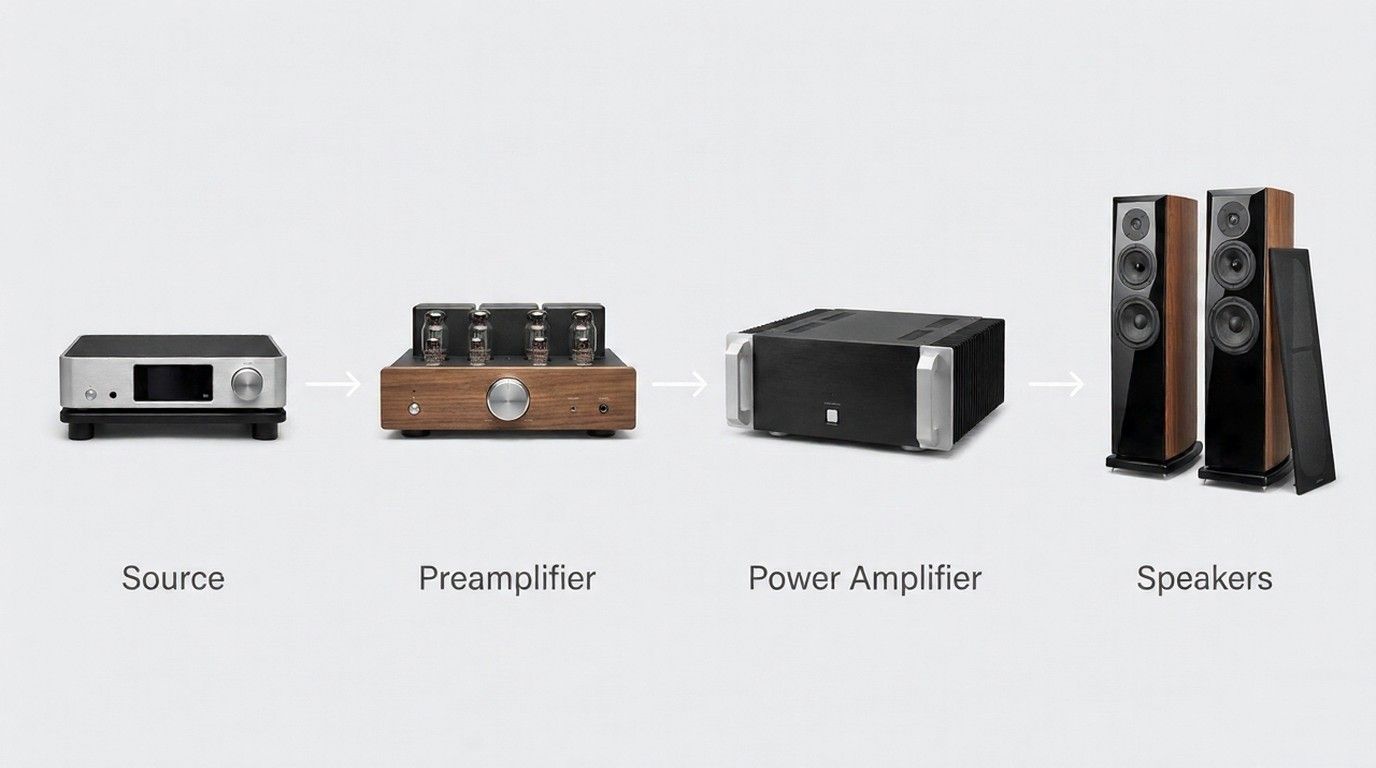
The power amplifier determines maximum volume, dynamic range, and speaker control; insufficient amplification results in distortion, compression, or clipping, which can damage speakers.
Amplifiers are categorized by function, internal architecture, and system integration. Each type serves a distinct role within an audio system.
A power amplifier is a standalone unit dedicated exclusively to driving speakers. It does not include volume control, source switching, or signal processing.
Power amplifiers are commonly used in:
The absence of preamp circuitry allows power amplifiers to focus on current delivery, thermal stability, and load handling.
An integrated amplifier combines a preamplifier and a power amplifier within a single chassis.
An integrated amplifier performs three core functions:
Integrated amplifiers reduce system complexity and are commonly used in two-channel home audio systems.
The difference between a power amplifier and an integrated amplifier lies in signal control and system role.
A power amplifier:
An integrated amplifier:
Power amplifiers offer greater system flexibility, while integrated amplifiers prioritize simplicity.
The difference between an integrated amplifier and an AV receiver is the scope.
An integrated amplifier:
An AV receiver:
AV receivers prioritize home theater functionality, while integrated amplifiers prioritize stereo audio performance.
Not all sound systems require a separate power amplifier. Amplification requirements depend on speaker design and system configuration.
Yes, passive speakers require an external amplifier.
Passive speakers do not contain internal amplification. Speaker drivers rely on an external power source to convert electrical signals into sound. A power amplifier supplies the necessary voltage and current to operate passive speakers safely and efficiently.
Yes, active speakers include built-in amplification.
Active speakers contain internal power amplifiers matched to the speaker drivers. The amplifier is optimized for impedance, sensitivity, and crossover characteristics. Active speaker systems do not require an external power amplifier.
No, soundbars and all-in-one speakers do not require an external amplifier.
Soundbars and all-in-one speaker systems include internal amplification and digital signal processing. These systems are designed to operate as self-contained audio solutions.
The required amplifier power depends on speaker sensitivity, impedance, listening distance, and room size.
Amplifier watts are measured as continuous power output into a specified load impedance, usually expressed in ohms.
Common power specifications include:
RMS power provides a realistic indication of sustained performance and thermal stability.
Speaker sensitivity directly affects how much amplifier power is required to reach a given volume level.
Speaker sensitivity is measured in decibels (dB) at 1 watt input from 1 meter distance. Higher sensitivity speakers produce more sound per watt.
For example:
Low-sensitivity speakers demand higher amplifier output to achieve the same sound pressure level.
Room size influences amplifier power by affecting listening distance and sound dispersion.
Larger rooms require:
Small rooms allow lower power requirements due to shorter listening distances and reduced air volume. Amplifier selection should account for both room dimensions and desired listening volume.
Speaker impedance determines how much electrical resistance a speaker presents to an amplifier. Correct impedance matching ensures stable operation, proper power delivery, and long-term system reliability.
Ohms are the unit of electrical resistance used to measure speaker impedance.
Speaker impedance represents opposition to alternating current across the audio frequency range. Common nominal impedance values include 4 ohms, 6 ohms, and 8 ohms. The impedance rating is an average value, not a constant measurement.
Impedance affects current draw, amplifier heat generation, and power output behavior.
A 4-ohm load draws more current from an amplifier than an 8-ohm load.
Lower impedance increases amplifier workload. When impedance is halved, the current demand approximately doubles under the same voltage. Many amplifiers produce higher power into 4 ohms but generate more heat and stress internal components.
An 8-ohm load is electrically easier to drive and improves amplifier efficiency and thermal stability.
When impedance drops below amplifier ratings, the amplifier may become unstable.
Excessive current draw can cause:
Amplifiers should only be operated within specified impedance limits to maintain reliability and sound quality.
Speaker wiring configuration directly changes the total load impedance seen by the amplifier.
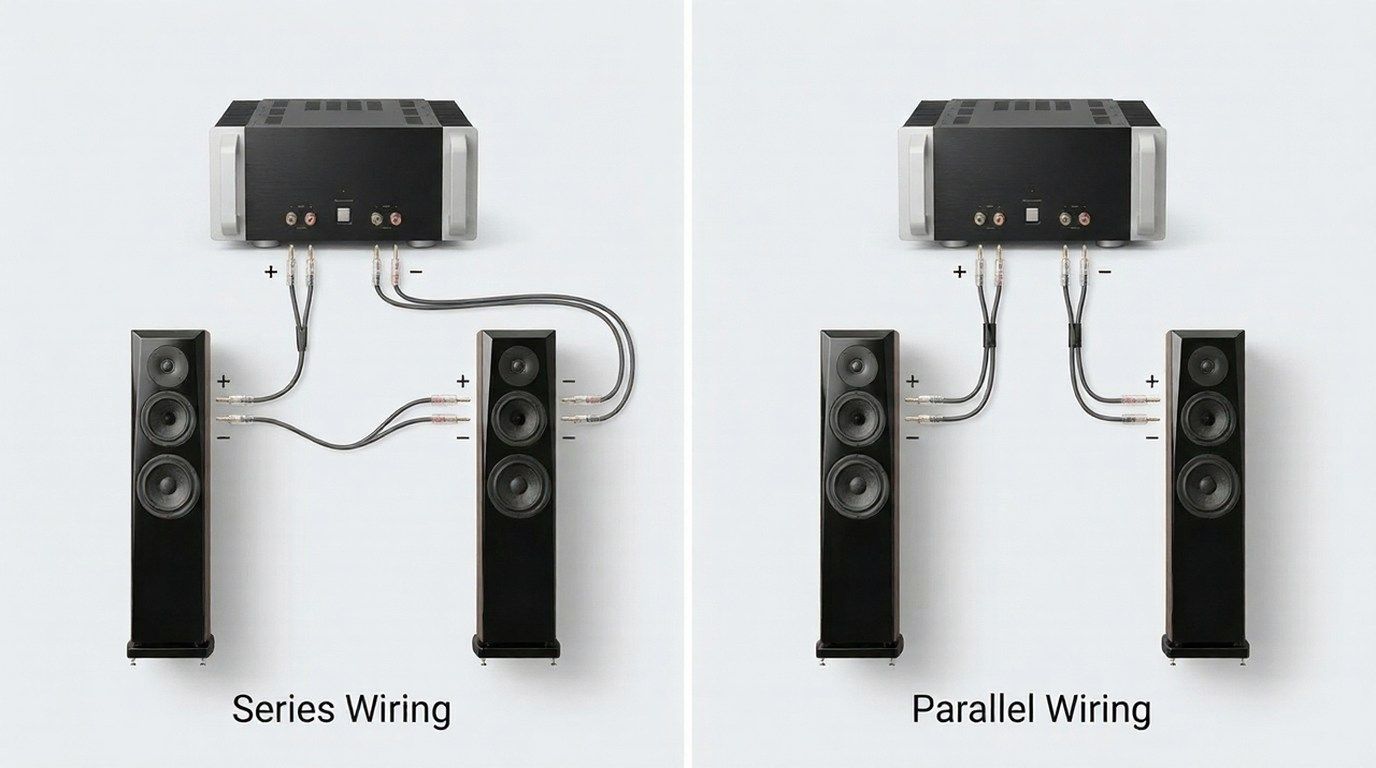
Series speaker wiring connects speakers end-to-end, increasing total impedance.
In series wiring, impedance values add together. Two 8-ohm speakers wired in series create a 16-ohm load. Series wiring reduces current demand but lowers total power delivered to each speaker.
Parallel speaker wiring connects speakers across the same amplifier terminals, decreasing total impedance.
In parallel wiring, impedance is divided. Two 8-ohm speakers wired in parallel create a 4-ohm load. Parallel wiring increases current demand and power distribution but places greater stress on the amplifier.
Wiring configuration determines how much electrical load the amplifier must drive.
Series wiring increases impedance and reduces amplifier stress. Parallel wiring lowers impedance and increases current demand. Incorrect wiring configurations can cause impedance values to fall below safe operating limits.
Proper wiring ensures amplifier stability and consistent power delivery.
Amplifier headroom describes the amount of unused power capacity above normal listening levels.
Headroom is the difference between an amplifier’s continuous operating level and its maximum output capability. It represents reserve power available for transient peaks.
Adequate headroom prevents signal clipping during sudden increases in volume.
Insufficient headroom increases distortion.
When an amplifier reaches its maximum output, clipping occurs. Clipping compresses the dynamic range and introduces harmonic distortion. Adequate headroom allows clean reproduction of dynamic peaks without altering the audio signal.
Higher headroom improves clarity, transient accuracy, and listening comfort.
Amplifier classes describe how output devices conduct electrical current during signal amplification. Each class balances efficiency, heat generation, and sound performance differently.
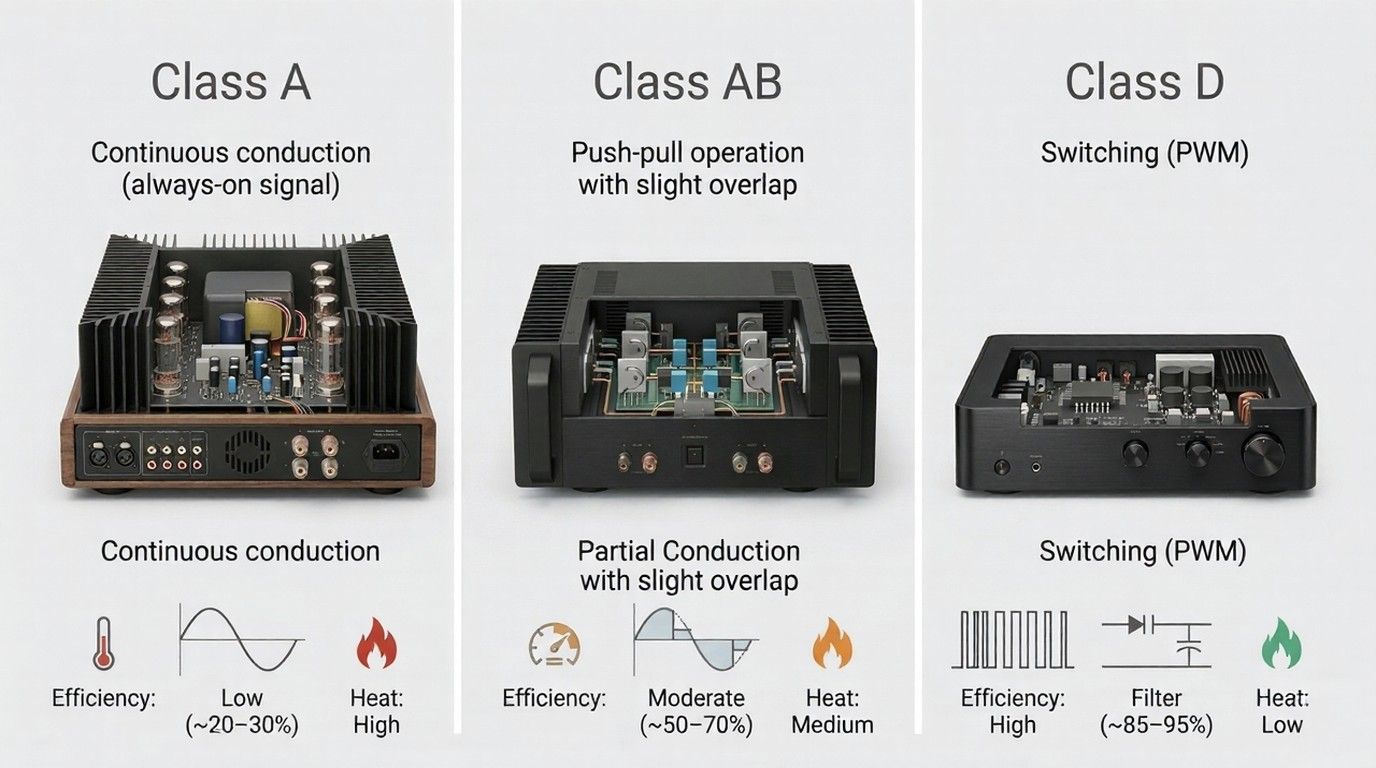
A Class A amplifier conducts current continuously through its output devices.
Class A designs offer:
Class A amplifiers generate significant heat and operate with low electrical efficiency.
A Class AB amplifier combines characteristics of Class A and Class B operation.
Class AB designs:
Class AB amplifiers are widely used in home audio and professional systems.
A Class D amplifier uses high-speed switching to amplify audio signals.
Class D designs offer:
Modern Class D amplifiers provide high power output with minimal energy loss, making them suitable for portable, home, and professional applications.
Amplifier bridging combines two amplifier channels to deliver higher output power to a single speaker load.
Bridging an amplifier means configuring two channels to operate as a single, higher-power channel.
In bridged mode, one channel drives the positive signal while the other drives the negative signal. This doubles the voltage available to the speaker.
Bridging increases output power by increasing the voltage swing.
When the voltage doubles, power output increases by approximately four times, assuming impedance remains constant. Increased current demand accompanies this power increase.
Bridging is commonly used for subwoofers and high-output speaker systems.
Bridged mode requires higher speaker impedance than stereo operation.
An amplifier rated for 4 ohms per channel typically requires an 8-ohm speaker when bridged. Lower impedance loads in bridged mode can exceed current limits and trigger protection circuits.
Always follow the manufacturer's impedance guidelines for bridged operation.
Protection features prevent damage to amplifiers and speakers during abnormal operating conditions.
A limiter restricts the maximum output level.
Limiters prevent clipping by reducing the signal level before distortion occurs. This protects speaker drivers from excessive power and prevents amplifier overload during transient peaks.
Thermal protection circuits monitor amplifier temperature.
When the temperature exceeds safe limits, output is reduced or shut down to prevent damage. Overcurrent protection monitors electrical current and disconnects the output if the current exceeds safe thresholds.
These protection systems increase amplifier lifespan and operational safety.
Amplifier specifications describe electrical performance, compatibility, and signal integrity. Evaluating these specifications prevents mismatch, distortion, and long-term reliability issues.
Power output per channel indicates how much continuous power an amplifier can deliver to each speaker.
Power is expressed in watts RMS at a specified impedance, such as 8 ohms or 4 ohms. Higher power output supports greater volume and dynamic range, but must align with speaker power handling and sensitivity.
Power ratings should be evaluated per channel, not combined or peak values.
Total Harmonic Distortion measures the amount of unwanted harmonic content added to the signal.
THD is expressed as a percentage. Lower values indicate cleaner signal reproduction. Most high-quality amplifiers operate below 0.1% THD at rated output.
Excessive THD causes audible harshness and loss of clarity, especially at higher volumes.
The signal-to-noise ratio measures the difference between the desired audio signal and background noise.
SNR is expressed in decibels (dB). Higher values indicate lower noise levels. An SNR above 90 dB is generally suitable for home audio systems.
Low SNR introduces hiss and reduces perceived dynamic range during quiet passages.
The frequency response range defines the span of audio frequencies an amplifier can reproduce accurately.
Most amplifiers cover the audible range of 20 Hz to 20 kHz. A flat frequency response across this range ensures tonal accuracy and prevents coloration.
Extended frequency response supports better phase behavior and transient accuracy.
Connectivity options determine system compatibility and flexibility.
Common input types include:
Output options include:
Balanced connections improve noise rejection in long cable runs and professional environments.
Power amplifiers require a line-level signal from an external source or control device.
DACs, streamers, and preamplifiers provide line-level output suitable for power amplifiers.
A digital-to-analog converter converts digital audio into analog signals. A streamer delivers network-based audio content. A preamplifier controls volume and source selection.
These devices connect to power amplifiers using RCA or XLR cables, depending on supported interfaces.
Turntables output a low-level phono signal that requires amplification and equalization.
A phono preamplifier boosts the signal to line level and applies RIAA equalization. The phono preamp then connects to a power amplifier through a line-level output.
Direct turntable connection to a power amplifier is not possible without a phono stage.
Amplifier selection should reflect the listening environment, content type, and operational demands.
Home hi-fi systems prioritize sound accuracy and dynamic control.
Amplifiers for hi-fi use should offer:
Integrated amplifiers or separate preamp and power amp configurations are common in this use case.
Home theater systems require multi-channel amplification and synchronization with video sources.
Amplifiers for AV systems should support:
External power amplifiers are often used to drive front or surround channels in high-output systems.
Professional audio systems prioritize output power, efficiency, and reliability.
Amplifiers for PA use should provide:
Class D amplifiers are commonly used due to efficiency and thermal performance.
Several recurring mistakes reduce performance and system longevity.
Undersupplying power leads to clipping and speaker damage. Ignoring impedance compatibility causes instability and overheating. Overlooking ventilation and efficiency results in thermal stress and premature failure.
Correct amplifier selection prevents these issues.
Choosing the right power amplifier requires aligning technical specifications with real-world conditions.
Speaker impedance and sensitivity determine required current and power. Room size influences output needs and headroom. The listening use case defines efficiency, channel count, and connectivity requirements.
System balance is achieved when amplifier capability exceeds minimum demands without unnecessary excess.
A power amplifier should match speaker impedance, provide sufficient continuous power, and maintain low distortion across the audible frequency range. Proper headroom, protection features, and connectivity ensure long-term stability and system compatibility.
Accurate amplifier selection improves sound clarity, protects equipment, and supports consistent performance across listening environments.
