
Wireless earbuds are compact audio devices that deliver sound without a physical cable connection to a playback device. Mobile lifestyles, deep smartphone integration, and improvements in wireless audio technology drive their popularity. Choosing the right wireless earbuds requires understanding how they work, how designs differ, and which features matter most for specific use cases.
Wireless earbuds are in-ear audio devices that receive sound wirelessly instead of through an analog cable. Each earbud contains a speaker driver, Bluetooth module, rechargeable battery, and control circuitry. These components work together to receive, process, and reproduce digital audio in a small, portable form.
Audio transmission is handled primarily through Bluetooth. The source device encodes audio data and sends it over a short-range wireless signal to the earbuds. This process includes pairing, compression, transmission, and decoding. Bluetooth version, signal quality, and interference directly affect connection stability, latency, and playback consistency.
Sound quality and functionality depend on codecs, drivers, and microphones. Codecs manage how audio is compressed and decompressed, influencing clarity and delay. Drivers convert electrical signals into sound, shaping volume, bass response, and frequency balance. Microphones capture voice and ambient sound for calls, voice assistants, and noise control features.
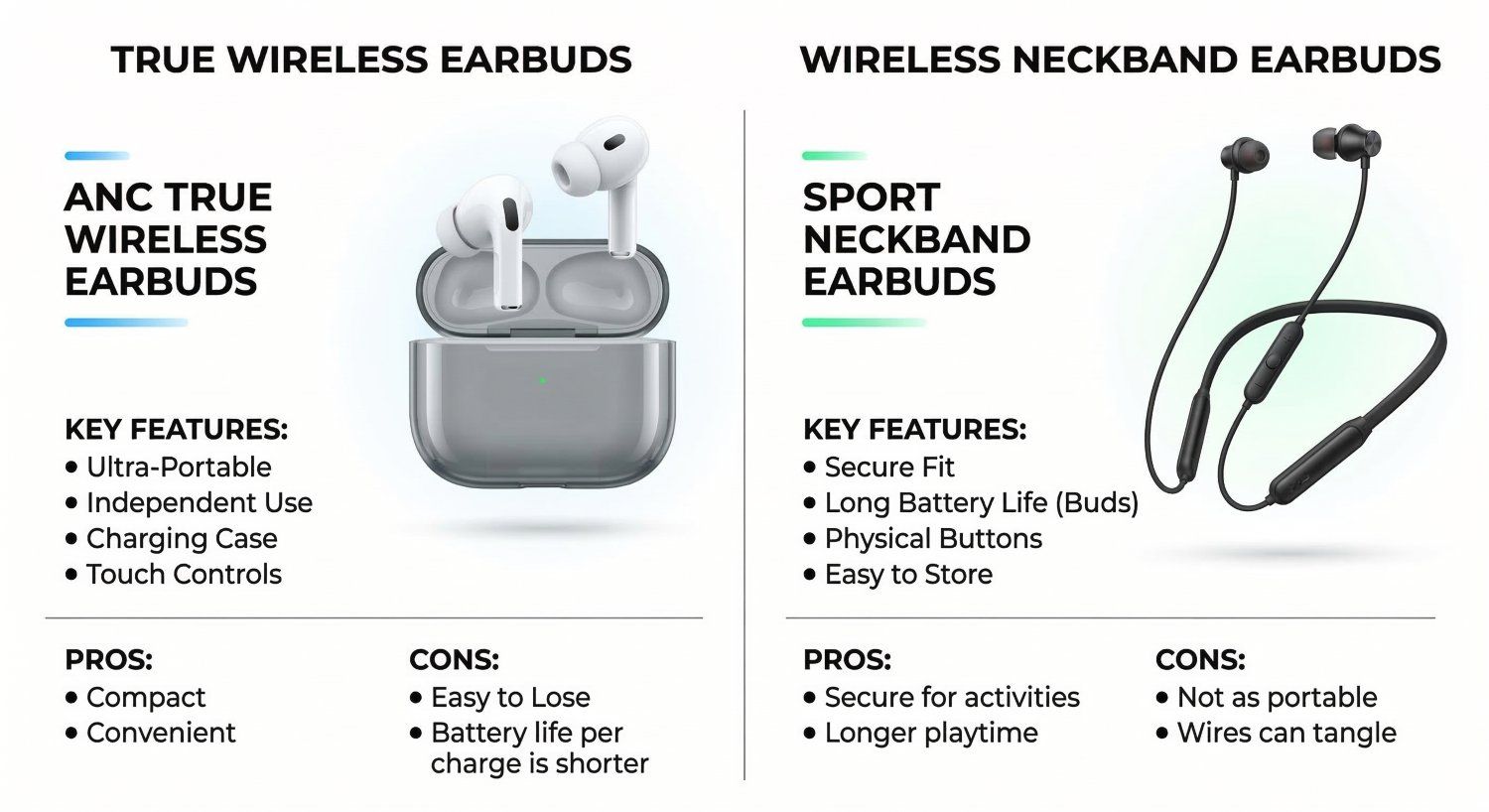
True wireless earbuds are fully cable-free audio devices, with no wire connecting the left and right earpieces. Each earbud operates independently and relies on wireless communication for synchronization and control.
The key difference between wireless and true wireless earbuds is physical design. Some wireless earbuds use a connecting cable or neckband, while true wireless models eliminate all external wiring. This increases portability and freedom of movement but requires more advanced internal synchronization.
Each true wireless earbud includes its own battery, Bluetooth chipset, driver, and processing hardware. This design allows single-ear use for calls or awareness but demands precise timing to maintain balanced stereo sound.
The charging case is essential to true wireless operation. It stores and protects the earbuds while providing multiple recharges. The case often manages pairing, resetting, and firmware-related functions in addition to extending total listening time.
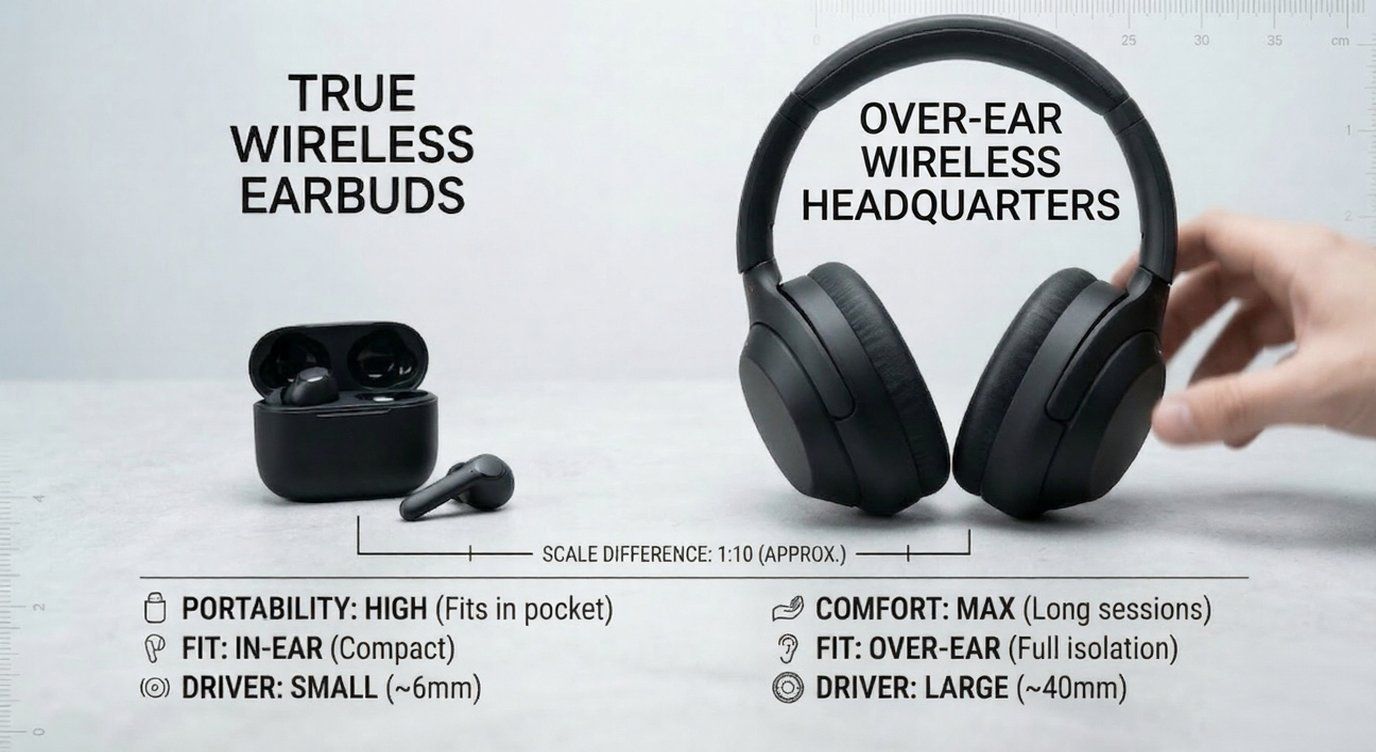
Wireless earbuds and wireless headphones differ in structure and listening experience. Wireless earbuds sit inside the ear canal and rely on ear tips for stability and isolation. Wireless headphones rest on or around the ears, using padded ear cups and a headband to support larger internal components.
Soundstage and isolation also differ. Wireless headphones generally offer a wider soundstage due to larger drivers and greater acoustic space. Wireless earbuds depend on a tight in-ear seal to improve bass and reduce external noise, with isolation quality largely determined by fit and noise control features.
Portability and battery capacity further separate the two formats. Wireless earbuds prioritize small size and low weight, making them easy to carry but limiting battery capacity. Wireless headphones support larger batteries for longer continuous playback, at the cost of reduced portability.
Wireless earbuds provide cable-free usability, allowing unrestricted movement during daily activities. The absence of wires reduces tangling, simplifies handling, and improves practicality for commuting, exercise, and multitasking.
Portability is a core advantage. Compact earbuds and small charging cases fit easily into pockets or bags, supporting frequent, on-the-go use with minimal storage requirements.
Smartphone and voice assistant integration further enhances usability. Wireless earbuds connect directly to mobile operating systems through Bluetooth and companion apps, enabling call handling, touch controls, voice assistant access, and sound customization. Built-in microphones support hands-free interaction without needing to access the phone.
Despite their convenience, wireless earbuds have inherent limitations. Their small size restricts battery capacity, resulting in shorter listening time per charge compared to larger audio devices. Charging cases extend total usage but require frequent recharging, especially when features like noise cancellation are active.
Loss risk and durability are ongoing concerns. Individual earbuds are easy to misplace, particularly during travel or physical activity. Exposure to moisture, earwax, and repeated handling can also degrade internal components over time without proper care.
Latency and compression are additional trade-offs. Bluetooth transmission requires audio compression, which can reduce sound fidelity compared to wired connections. Latency may cause noticeable delays between audio and visuals, especially during gaming or video playback when low-latency modes are unavailable.
High-quality wireless earbuds are defined by a combination of acoustic components, wireless performance, power efficiency, and user interface design. These features determine overall listening experience, reliability, and long-term usability.
Audio drivers are responsible for converting electrical signals into audible sound. Dynamic drivers are commonly used due to their ability to produce a strong bass response and balanced sound across a wide frequency range. Balanced armature drivers focus on precision and clarity, particularly in mid and high frequencies, and are often used in multi-driver configurations.
Frequency response and tuning profiles influence how sound is perceived across low, mid, and high ranges. A well-tuned frequency response ensures clarity without distortion, while tuning profiles shape the overall sound signature, such as neutral, bass-enhanced, or vocal-focused reproduction.
Bluetooth versions determine connection stability, range, and energy efficiency. Newer versions improve signal reliability and reduce power consumption. Audio codecs such as SBC, AAC, aptX, and LDAC manage how sound is compressed and transmitted, affecting clarity and latency.
Codec compatibility with devices plays a critical role in performance. Both the source device and earbuds must support the same codec to achieve optimal audio quality. Incompatible codecs default to basic compression standards, which may reduce sound fidelity.
Playback time per charge defines how long earbuds can operate continuously before requiring recharging. Battery performance varies depending on volume level, codec usage, and feature activation, such as active noise cancellation.
Total charge cycles from the charging case extend overall usage by providing multiple recharges. Case capacity determines how many times the earbuds can be fully recharged before the case itself needs power, directly influencing convenience during travel or extended use.
Active noise cancellation reduces unwanted ambient sound by generating opposing sound waves. Feedforward systems use external microphones to detect environmental noise, while feedback systems rely on internal microphones to monitor sound reaching the ear. Some earbuds combine both methods for improved effectiveness.
Environmental awareness modes, often called transparency or ambient modes, allow external sounds to pass through intentionally. These modes improve situational awareness in public spaces and support safer use during commuting or outdoor activities.
Microphone quality directly affects voice clarity during calls and virtual meetings. Beamforming microphones focus on the user’s voice while minimizing background noise by isolating sound directionally.
Noise reduction algorithms further enhance call performance by filtering ambient sounds such as wind, traffic, or crowd noise. Effective processing improves speech intelligibility in noisy environments.
Touch controls enable users to manage playback, calls, and voice assistants through gestures such as taps or swipes. Reliable gesture recognition reduces the need to access the connected device frequently.
Wear detection sensors identify when earbuds are inserted or removed from the ears. These sensors automatically pause or resume playback, improving power efficiency and user convenience.
Fit and comfort play a critical role in both audio quality and long-term usability. Proper in-ear positioning ensures consistent sound reproduction and reduces listener fatigue.
An effective in-ear seal enhances sound isolation by limiting external noise intrusion. A secure seal improves bass response and stabilizes sound performance, particularly in environments with background noise.
Silicone ear tips offer durability and ease of cleaning, making them suitable for everyday use. Foam ear tips adapt to the ear canal shape, providing improved isolation and stability, though they may wear out faster over time.
Long-duration comfort depends on earbud weight, pressure distribution, and material quality. Poor ergonomic design can cause discomfort during extended listening sessions, affecting overall user satisfaction.
Wireless earbuds can remain secure during physical activity when designed with stability-focused features. Secure fit is essential for maintaining consistent sound and preventing loss during movement.
Stability during running and workouts depends on how well the earbuds distribute weight and anchor within the ear. Sudden movements and repetitive motion can dislodge poorly fitted earbuds.
Ear-fin and wing-tip designs improve retention by providing additional contact points within the ear. These structures help stabilize earbuds without increasing pressure inside the ear canal.
Weight distribution and ergonomic shaping influence how earbuds remain balanced during activity. Lightweight construction combined with anatomical contouring reduces movement and enhances overall stability.

Wireless earbuds adapt to a wide range of environments when their features align with specific usage needs. Performance expectations vary based on activity type and listening priorities.
Noise cancellation is a priority for commuting and travel, as it reduces engine noise, crowd sounds, and environmental distractions. Effective isolation improves listening clarity in noisy settings.
Compact charging cases enhance portability during travel. Smaller cases occupy less space while providing sufficient power reserves for extended use throughout the day.
Sweat and water resistance ratings indicate protection against moisture exposure during exercise. Higher ratings improve durability during intense workouts or outdoor activities.
Secure-fit design is essential for fitness use. Earbuds must remain stable during repetitive motion without causing discomfort or pressure buildup.
Microphone clarity is critical for professional communication. Clear voice capture ensures effective participation in calls and virtual meetings.
Multipoint connectivity allows earbuds to connect to multiple devices simultaneously. This feature supports seamless switching between computers and smartphones without manual reconnection.
Low-latency modes reduce audio delay during gaming and video playback. Minimizing latency improves synchronization between sound and on-screen action.
Audio-video synchronization ensures that dialogue and sound effects align accurately with visual content. Proper synchronization enhances immersion and prevents perceptual disruption.
IP ratings describe the level of protection wireless earbuds have against water and particulate exposure. The designation is standardized and indicates how well internal components are sealed against external elements. Ratings such as IPX4, IPX5, and IPX7 focus specifically on water resistance, with the “X” indicating that dust resistance has not been formally tested.
An IPX4 rating indicates protection against water splashes from any direction, making earbuds suitable for light rain and sweat exposure. IPX5 extends protection to low-pressure water jets, offering greater resilience during workouts or outdoor use. IPX7 signifies resistance to temporary immersion in water, typically up to one meter for a limited duration, which provides added security against accidental drops into water.
Despite these ratings, protection limitations remain. Water resistance does not imply waterproofing, and repeated exposure to moisture can degrade seals over time. Charging cases often have lower resistance than the earbuds themselves, and saltwater or soap exposure can cause damage even within rated thresholds.
Wireless earbuds integrate with smartphones through Bluetooth connectivity and operating system-level audio frameworks. Compatibility with Android and iOS determines how seamlessly features such as pairing, device switching, and voice assistant access function. While basic audio playback works across platforms, advanced features may vary depending on system support.
Android and iOS compatibility affects codec availability, system controls, and background behavior. Some earbuds support platform-specific features such as fast pairing, spatial audio processing, or voice assistant optimization, depending on the operating system and device manufacturer.
App-based equalizers and firmware updates extend functionality beyond default system controls. Companion applications allow users to adjust sound profiles, customize touch controls, manage noise modes, and install firmware updates. Firmware updates improve stability, fix bugs, and occasionally introduce new features, contributing to long-term usability.
Budget wireless earbuds offer basic functionality at lower price points, but cost reductions introduce trade-offs in materials, components, and feature sets. Construction quality may be lower, using simpler plastics and less durable charging mechanisms. Codec support is often limited to standard formats, which can affect audio clarity and latency.
Performance expectations should align with price tiers. Entry-level earbuds typically provide acceptable sound for casual listening but may lack advanced noise control, long battery life, or refined tuning. Mid-range options often balance cost and performance more effectively, offering improved drivers, better microphones, and enhanced app support without premium pricing.
Regular cleaning and maintenance preserve both hygiene and performance. Earwax buildup can obstruct sound output and reduce clarity, making gentle removal essential. Dry brushing or soft tools should be used to clear debris without pushing material further into the speaker mesh.
Charging contact maintenance ensures consistent power transfer between the earbuds and the charging case. Contacts should be kept dry and free from residue to prevent charging interruptions. Moisture or debris on contact points can lead to incomplete charging or connection errors.
Storage best practices reduce wear and environmental exposure. Earbuds should be stored in their charging case when not in use, away from excessive heat, humidity, or dust. Proper storage minimizes accidental damage and supports battery longevity.
Long-term durability depends on both component quality and usage patterns. Battery degradation is a primary limiting factor, as lithium-based batteries lose capacity over time. Frequent charging cycles gradually reduce playback duration, eventually limiting usability.
Hinge and case wear affect mechanical reliability. Repeated opening and closing of the charging case can loosen hinges or weaken magnetic closures. Structural wear increases the risk of damage during transport.
Firmware support lifecycle influences long-term performance. Continued software updates improve stability and compatibility with newer devices. Lack of firmware support may lead to connectivity issues or reduced functionality as operating systems evolve.
Selecting wireless earbuds requires prioritizing features based on individual needs rather than maximum specifications alone. Core considerations include audio quality, battery performance, connectivity stability, and comfort.
Use-case alignment ensures that earbuds match intended activities, such as commuting, fitness, remote work, or media consumption. Features such as noise cancellation, water resistance, or low-latency modes become more relevant depending on context.
Performance-to-cost evaluation balances feature availability against price. The optimal choice delivers reliable performance, sufficient durability, and necessary features without paying for unused capabilities.
